
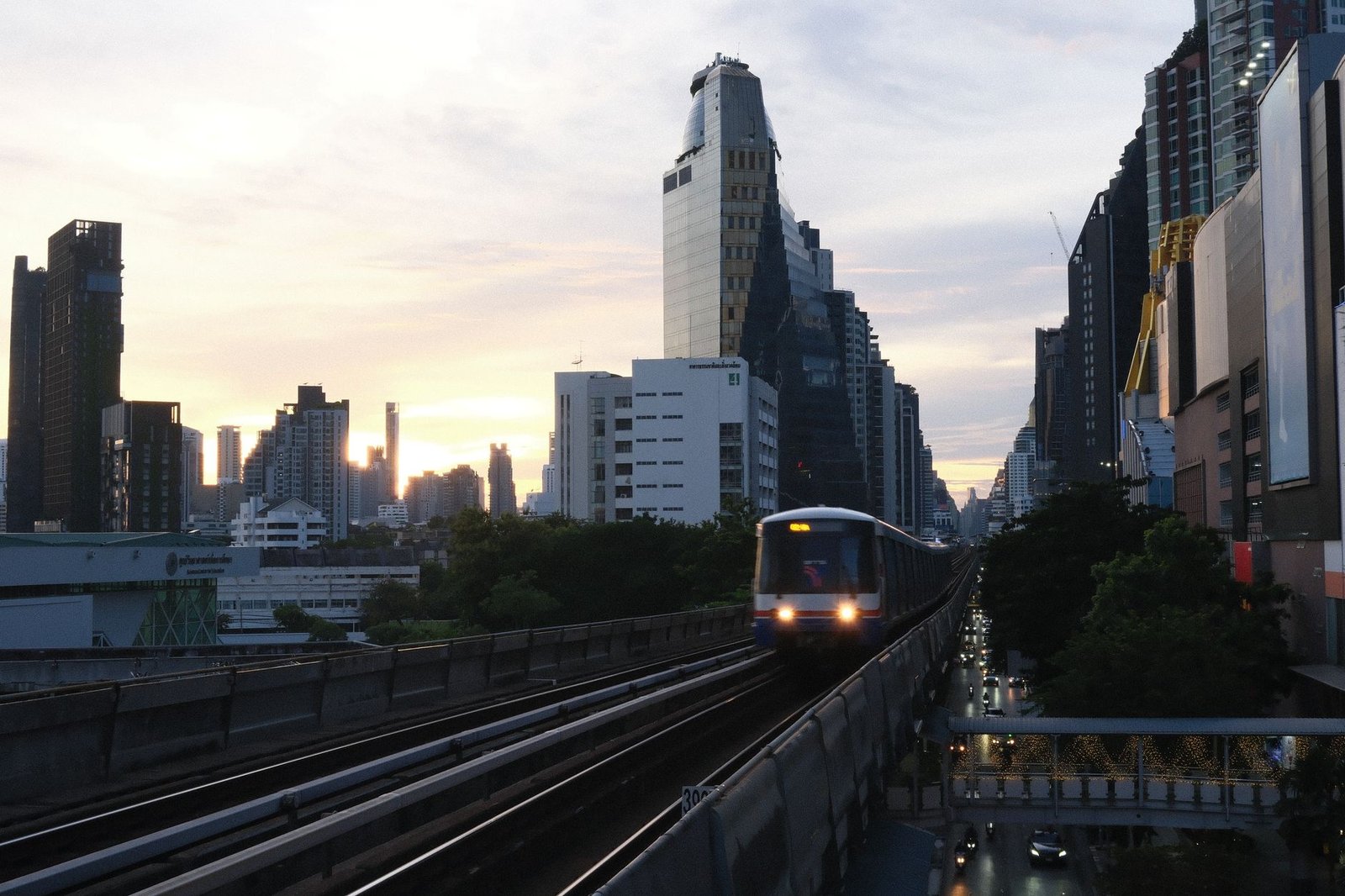
In Bangkok you are not choosing a neighbourhood. You are choosing a station. Traffic turns a two kilometre taxi ride into forty minutes at six in the evening, so a hotel ten minutes walk from the BTS or MRT beats a nicer one that is not.
Get that wrong and you pay twice, in fares and in the hours you spend stationary. Here is what each area costs, what it is like at two in the morning, and which line it puts you on. For what those lines get you to, see Things to Do in Bangkok.
The short answer
Stay in Siam or Ratchathewi on a first trip. You are on the BTS interchange, two stops from the Airport Rail Link at Phaya Thai, and close enough to the old town to reach the Grand Palace before the queues build.
Lower Sukhumvit around Asok or Phrom Phong is the better base for a second trip or a longer one. Skip Khao San unless you intend to be part of the noise rather than sleep through it.
| Area | Suits | Avoid if | Indicative double, November 2026 | Rail |
|---|---|---|---|---|
| Siam and Ratchathewi | First trip, shopping, day trips out | You want quiet evenings | 2,000 to 4,200 baht | BTS interchange at Siam, ARL at Phaya Thai |
| Lower Sukhumvit, Asok to Phrom Phong | Second trip, food, easy transfers | You are travelling with children | 2,000 to 4,500 baht | BTS Sukhumvit line, MRT Blue at Sukhumvit |
| Silom and Sathorn | Weekend quiet, river access, business | You want life on a Sunday night | 2,300 to 6,600 baht | BTS Silom line, MRT Blue at Si Lom and Lumphini |
| Riverside and Charoen Krung | Hotel as the destination | You are on a schedule | 8,300 baht and up | BTS Saphan Taksin, express boat piers |
| Old town, Rattanakosin | Temples, early starts, walking | You need the BTS network | 1,200 to 3,000 baht | MRT Sanam Chai and Sam Yot |
| Ari and Phaya Thai | Longer stays, cafes, airport runs | You want to walk to nightlife | 1,500 to 3,000 baht | BTS Sukhumvit line, ARL at Phaya Thai |
| Ratchada and Huai Khwang | Cheapest rail-connected beds | You want walkable streets | 900 to 2,000 baht | MRT Blue line |
Those bands are indicative, not quoted rates. Check them against live prices for your own dates before you trust them.
How much should a night actually cost?
Bangkok hotels averaged 3,660 baht a night across the city in the April to June quarter of 2026, on 73 percent occupancy, according to Cushman & Wakefield. Knight Frank put the first half of 2025 at 4,260 baht. Rates have softened, not risen. Above about 4,000 baht for a mid-range room you are paying a location or peak-date premium, and it is worth knowing which.
Then add the tax. Thai hotels above guesthouse level quote rates plus 10 percent service charge plus 7 percent VAT, and the VAT is usually applied after the service charge. A rate of 1,000 baht becomes 1,177 baht. Budget 17.7 percent on top of any rate written with two plus signs after it, and read the booking page breakdown rather than the headline.
At 33.1 baht to the dollar on 11 August 2026 that average is about 110 dollars. High season runs November to February and pushes central rates up. The wet months, June to October, are when discounts appear.
Which area fits which traveller?
Siam and Ratchathewi
This is the middle of the BTS map. Siam is the only interchange between the two Green Line branches, so nowhere on the network is more than one change away. Phaya Thai puts you on the Airport Rail Link, which is 45 baht from Suvarnabhumi. It suits a first trip and anyone planning day trips out. Avoid it if you want a neighbourhood rather than a district of shopping centres. Noise is traffic rather than bars, so ask for a room off Phaya Thai Road.
Lower Sukhumvit, Asok to Phrom Phong
The densest concentration of decent mid-range hotels in the city, with the BTS overhead and the MRT Blue Line crossing at Asok. It suits repeat visitors and anyone who came for the food. Avoid it with children, and avoid the stretch between Nana and Asok if the red-light trade bothers you. Soi Cowboy sits beside Asok station and Nana Plaza a few hundred metres west, both loud until two. Even-numbered sois run south and are quieter than the odd-numbered ones north.
Silom and Sathorn
The financial district, so it empties at the weekend. You get the BTS Silom line, two MRT stations and a short hop to the river at Saphan Taksin. It suits business trips and light sleepers who want a calm base near Lumphini Park. Avoid it if you want somewhere alive on a Sunday. Patpong is contained within two streets, unlike the Sukhumvit equivalents.
Riverside and Charoen Krung
Where the famous hotels are, priced from around 8,300 baht and climbing without limit. It suits a stay where the hotel is the point. Avoid it if you have a list of things to see, because the river is slow and the road route into town is the worst in the city at rush hour. Only Saphan Taksin is on the BTS, so check which pier your hotel shuttle uses. Nights are quiet and the boats stop early.
Old town, Rattanakosin
The temples are here, and so are the early starts that beat the queues at the Grand Palace. The MRT Blue Line now reaches Sanam Chai and Sam Yot. It suits second-time visitors who would rather walk than ride. Avoid it if your plans sit on the BTS network, because every trip becomes a change. Rooms run 1,200 to 3,000 baht and nights are quiet, with the exception below.
Ari and Phaya Thai
Two stops north of the shopping district, residential, with the cafe and small restaurant density that central areas lost. It suits stays over a week and early flights, given Phaya Thai is the Airport Rail Link terminus. Avoid it if you want to walk home from a bar at midnight. Rates run 1,500 to 3,000 baht and the streets are quiet after ten.
Ratchada and Huai Khwang
The cheapest way to sleep on a rail line, roughly 900 to 2,000 baht for a room that costs double on Sukhumvit. The MRT Blue Line runs its length. It suits budget travellers who still want a station. Avoid it if you want walkable pavements or a short trip to the temples. Ratchadaphisek Road has its own late-night economy, so check what sits below your window.
Where should you not stay?
Khao San Road, unless the noise is why you came. It is a bar street with rooms above it and no BTS or MRT station. The nearest are Sanam Chai and Sam Yot, and the closest BTS stations are about five kilometres off. The river route works, from Sathorn pier by Saphan Taksin BTS to Phra Arthit pier, but it stops in the evening. Dorm beds run about 260 to 400 baht and private guesthouse rooms 660 to 1,160 baht, which is the whole argument in its favour.
Anywhere more than about ten minutes on foot from a station. A cheaper room further out costs you two taxi rides a day and the traffic they sit in. Price the room and the transport together.
Pratunam and Ratchaprarop, if you assumed they were on the BTS. They are not. Ratchaprarop is an Airport Rail Link stop, useful for the airport and little else.
Airport hotels for a city trip. Suvarnabhumi is far enough out that a night there costs you a day.
What traps catch people?
The 20-baht fare headline. Thailand capped electric train fares at 20 baht a trip across the Bangkok network, but the cap is for Thai nationals who register through the Tang Rat app with a 13-digit Thai national ID. Foreign visitors pay standard fares. Budget 17 to 65 baht per BTS trip on the Green Line and 17 to 44 baht on the MRT Blue Line, whose current fares took effect on 3 July 2026 and run to July 2028.
Trusting a walking time from a map pin. Bangkok blocks are long, sois run deep and many dead-end, and crossings are scarce on the big roads. A hotel 400 metres from a station in a straight line can be a fifteen minute walk. Check the soi number and trace the route.
Reading a rate as the price. Add 17.7 percent for service and VAT unless the booking page states that taxes are included. On a seven night stay at 3,000 baht that is 3,717 baht you had not counted.
Buying a one-day BTS pass by default. At 150 baht it needs about four Green Line trips to beat single fares. Two trips a day does not get there.
Flying into Don Mueang and planning around the Airport Rail Link. The link only serves Suvarnabhumi. Don Mueang is on the SRT Red Line instead, which is a different journey into a different part of town.
Prepaying a 300-baht tourist entry fee. Thailand has approved one and postponed it repeatedly, and it was still not in force as of mid-2026. Nobody should be collecting it from you at booking.
Frequently asked questions
Where should a first-time visitor stay? Siam or Ratchathewi. The BTS interchange and the Airport Rail Link at Phaya Thai save more time than any other location advantage in the city.
Is Khao San Road a bad place to stay? For sleeping, yes. A dorm bed at 260 to 400 baht with no rail station and a bar street outside is a trade to make deliberately.
Do I have to be near the BTS or MRT? Effectively yes. The rail network is the only part of the transport system that ignores the traffic.
Do tourists get the 20-baht flat fare? No. It requires registration with a Thai national ID. Visitors pay the standard distance-based fares.
What is a fair price for a mid-range room? Around 2,000 to 4,000 baht before tax in a central area, against a citywide average of 3,660 baht in the second quarter of 2026.
When is Bangkok cheapest? June to October, the wet season. High season is November to February.
Sources: Bangkok hotel occupancy and average daily rate for Q2 2026, Cushman & Wakefield Thailand, reported at cushmanwakefield.com. H1 2025 hotel data, Knight Frank Thailand via nationthailand.com. BTS fares and the One-Day Pass, btsbangkok.com/fare. MRT Blue Line fares effective 3 July 2026, nationthailand.com. 20-baht flat fare scope and eligibility, bangkokpost.com and nationthailand.com. Airport Rail Link fares, bkkairportlink.com/fare. Tourist entry fee status, nationthailand.com. USD to THB rate on 11 August 2026, tradingeconomics.com.
Researched from primary sources and checked August 2026. General information, not advice.
