
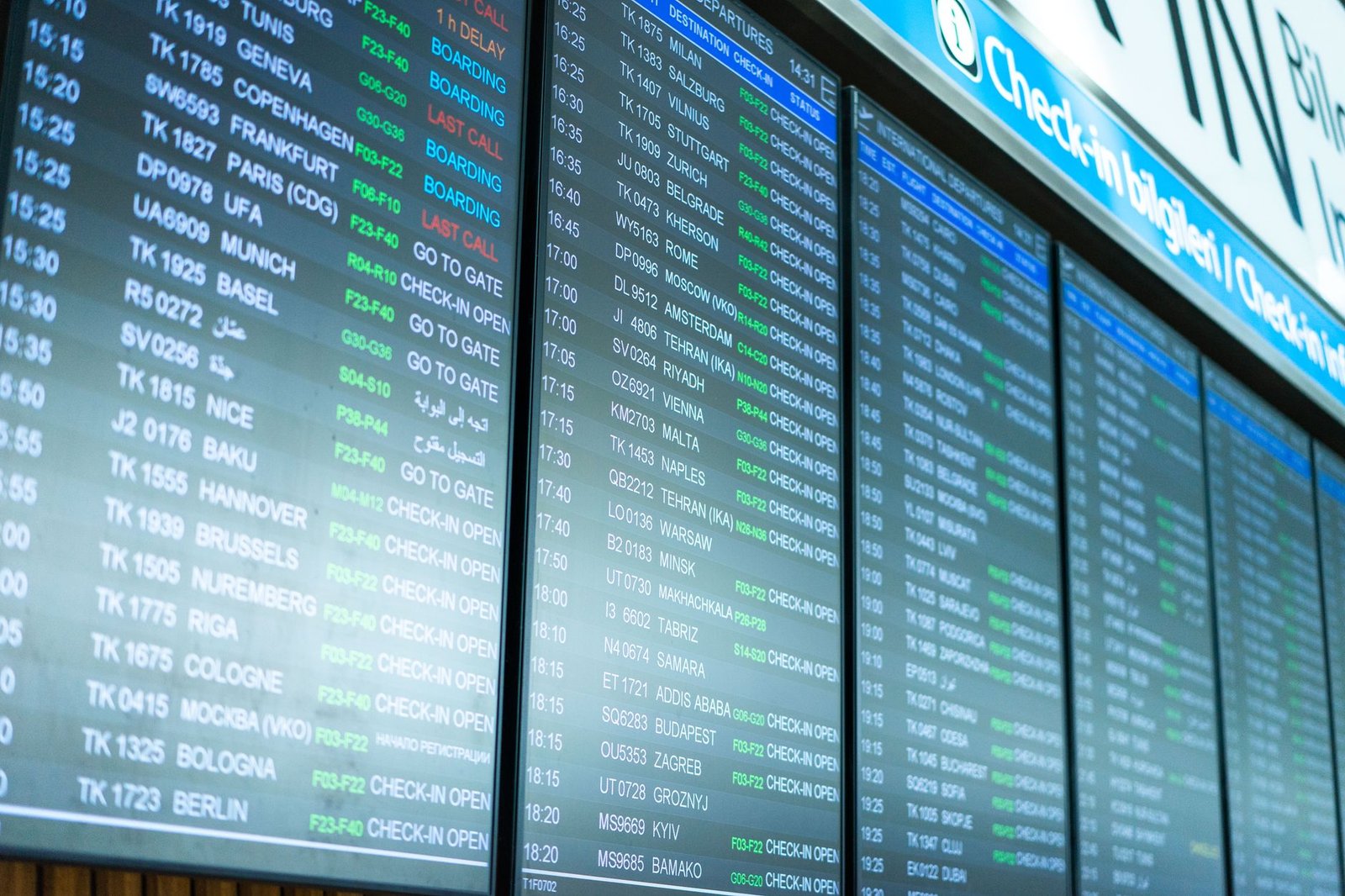
The flight is cancelled and the app offers you a seat three days later. Another airline has seats today, at a price you do not want to pay. The question is whose problem the law says that is.
The short answer
Under EU261 and UK261 the airline must re-route you to your final destination at the earliest opportunity, and the regulators are explicit that this includes seats on other airlines. What the law does not give you today is a deadline, which is why “our next available flight is Thursday” survives as an answer. You can buy your own ticket and bill the airline, but only after you have given it a genuine chance to re-route you and it has failed. Press the refund button first and you lose the re-routing claim outright.
| Where you fly from | Deadline to re-route you | Must they use other airlines? | Can you self-rebook and claim? |
|---|---|---|---|
| EU or UK, today | None. “Earliest opportunity” only | Yes. Regulator guidance says other carriers, other airports and other transport modes | Only if the airline failed to offer a suitable re-route in a reasonable time, and the spend was reasonable |
| EU, from mid 2027 | Three hours | Yes, plus alternative airports and a higher cabin at no extra cost | Yes, once three hours pass. Reimbursement capped at 400 per cent of the original ticket |
| United States | None. No re-routing duty | No. Only where an agreement exists | No. You get an automatic refund, not a ticket |
| Canada | 9 hours if the airline’s fault, 48 if not | Yes, any airline, once those windows are missed | No statutory self-rebooking right |
Outside the EU and the UK a replacement ticket is not a right, it is a commercial courtesy, and the rules for missed connections set out what those regimes pay instead.
What does the airline actually owe you when it cancels?
Article 8(1) gives you a choice of three things, and the airline has to put all three in front of you. Option (a) is reimbursement within seven days. Option (b) is “re-routing, under comparable transport conditions, to their final destination at the earliest opportunity”. Option (c) is re-routing later, at your convenience, subject to seats. While you wait for (b), Article 5(1)(b) obliges the airline to feed you and, if the re-route is the next day or later, to house you. Move you to a different airport in the same region and Article 8(3) makes it pay the transfer.
Now the part nobody is told at the desk. The European Commission’s interpretative guidelines state that once the passenger has chosen one of the three options, the carrier no longer has any obligation linked to the other two. The choice is made once. Accept the refund and the duty to find you a seat ends with it, even though you still need to be in Lisbon on Friday. Compensation under Article 7 is separate and survives either way.
Does “the earliest opportunity” mean their next flight?
No. The UK regulator has written down the order it expects airlines to work through. CAP 2155 sets out a ladder: a seat on the airline’s own or partner services, same day, same route. If that is impossible, a different airline, same day, same route. If that fails, the same day using nearby airports, indirect routings or another mode of transport. Only then does it move to the days either side.
The CAA names one limit. Airlines need not take “manifestly unreasonable steps”, which it illustrates with private jets and long-distance private taxis. A competitor’s fare is not on that list, so “their ticket costs more than yours did” is not a defence.
Two findings from Rusu v SC Blue Air (C-354/18) sit behind this. The airline must give you comprehensive information about the options, including flights on other airlines, and you are under no duty to research alternatives yourself. The burden of proving that what it offered really was the earliest opportunity sits with the airline.
So can you book your own ticket and send them the bill?
Sometimes, and the honest answer is narrower than the claims industry suggests. The CAA’s position is that if airlines follow that ladder, “it should therefore rarely be reasonable for affected passengers to make their own arrangements to re-route themselves”. Give the airline a real opportunity first.
The door opens where the airline has failed to contact you within a reasonable period. Those passengers, CAP 2155 says, “may then be justified in making their own arrangements and seeking reimbursement for the cost of doing so”, provided the spend meets the test from McDonagh v Ryanair: necessary, appropriate and reasonable.
The same guidance closes the door the other way. If the airline can show it contacted you, offered Article 8 assistance, and you bought your own ticket anyway, it can refuse the extra cost. That is the most common reason a self-rebooking claim dies.
One more provision is worth money. Where an airline never offers the choice and simply refunds you, the guidelines say you are entitled to further reimbursement of the price difference with the new ticket under comparable transport conditions. A silent refund is not the airline settling up. It is the airline owing you the gap.
How do you do it so the claim survives?
- Do not touch the refund button. It ends the re-routing duty.
- Ask in writing, immediately, for re-routing under Article 8(1)(b) including on other carriers, with a defensible deadline such as two hours for a same-day departure.
- Screenshot the seats available on other airlines that day, with times and fares. That is your evidence an earlier option existed.
- Keep the refusal, or the silence. A timestamped chat transcript beats a phone call nobody logged.
- Buy the cheapest reasonable equivalent. Same cabin, same or a nearby airport, no gratuitous upgrade.
- Claim the difference, attaching the request, the refusal, your evidence and the receipts.
- If it refuses, escalate to the airline’s approved dispute scheme in the UK, or the CAA where it uses neither, and to the national enforcement body of the departure country in the EU.
A message that does the job reads: “Flight [number] on [date] was cancelled. Under Article 8(1)(b) of Regulation 261/2004 I require re-routing to [destination] at the earliest opportunity, including on other carriers. Seats are available today on [airline, flight, time]. Please confirm by [time] or I will re-route myself and claim the cost.”
What changes in 2027?
The first real revision of EU261 since 2004 was agreed on 15 June 2026, approved by Parliament on 7 July 2026 by 646 votes to 12, and cleared by the Council on 13 July 2026. It puts a clock on all of this. If the airline fails to offer re-routing within three hours, you may arrange your own and claim reimbursement of up to 400 per cent of the original ticket price.
The duty is also written out properly. It covers an alternative airport, a different route, another airline’s services and other transport modes where suitable. You can be moved into a higher class at no extra cost, and if you booked a direct flight the replacement cannot add connections or cost. None of it helps a flight cancelled this week. The Council says the rules enter into force twelve months and twenty days after publication in the Official Journal, putting application in mid 2027.
One existing rule catches people out. Article 7(2) lets the airline halve your compensation if the re-route gets you there within two hours of the original arrival on flights of 1,500km or less, three hours between 1,500km and 3,500km, and four hours on anything longer. A fast re-route can legitimately cut €600 to €300.
Where these claims fail
Taking the refund and buying a replacement is the expensive mistake. You chose option (a), so the price gap is yours. Rebooking within minutes is the next one, because the airline has to have failed after a reasonable period, and fifteen minutes is not one. Buying a better seat than you held invites a reasonableness argument you will lose, and claiming by phone leaves you nothing to file. Many people also assume a refused re-route kills the compensation claim, when the two are independent and an extraordinary circumstances refusal is often wrong on its own terms.
Frequently asked questions
The airline offered a flight two days out plus a hotel. Is that lawful? It can be, if no earlier option existed on any carrier, and the hotel is owed in the meantime under Article 5(1)(b). Ask what it checked. The burden of showing the offer was the earliest opportunity is on the airline.
Can I insist on business class if that is all the other airline has left? You cannot demand an upgrade, because the standard is comparable conditions rather than better ones. If a higher cabin is the only way to re-route you, the guidelines say it should still cost you nothing.
Do I get cash compensation as well as a new seat? Yes. Re-routing is assistance, and compensation is a separate entitlement under Article 7, subject to the halving rule above and the usual distance bands. Article 12 also leaves the door open to further damages in a national court.
I booked through an agent and nobody is replying. What now? The refund may run through the agent, but the Article 8 duty sits with the operating carrier, so aim the re-routing demand at the airline. If both go quiet, a card claim runs in parallel, and the chargeback and Section 75 playbook sets out which one applies and how long you have.
Sources: Regulation (EC) No 261/2004, Articles 5, 7, 8, 9 and 12, as retained in UK law (legislation.gov.uk). UK Civil Aviation Authority, CAP 2155, “Re-routing in accordance with Article 8 of Regulation (EU) 261/2004 and the CAA’s view on compliance”, May 2021 (caa.co.uk). European Commission, Interpretative Guidelines on Regulation (EC) No 261/2004, OJ C, 25 September 2024, section 4.2 (eur-lex.europa.eu). Court of Justice of the European Union, C-354/18 Rusu v SC Blue Air, and C-12/11 McDonagh v Ryanair. Council of the European Union, “Council gives final clearance for stronger air passenger rights”, 13 July 2026, and “Council and Parliament reach landmark agreement on stronger EU air passenger rights”, 15 June 2026 (consilium.europa.eu). US Department of Transportation, Refunds and Flight Delays and Cancellations guidance (transportation.gov). Canadian Transportation Agency, Air Passenger Protection Regulations sections 17 and 18, and “Flight Delays and Cancellations: A Guide” (otc-cta.gc.ca).
Researched from primary sources and checked September 2026. General information, not advice.
