
If your flight was delayed by three hours or more, cancelled at short notice, or you were bumped off it, European law may owe you between €250 and €600. In cash. Not a voucher, not air miles.
Most people never claim it. Airlines have no duty to mention it at the gate, and the industry knows perfectly well that most eligible passengers just go home.
Here is when you qualify, how much you get, and how to claim it yourself instead of handing a third of it to a claims company.
Or skip the reading: the flight compensation checker works out the amount for your exact route and writes the claim letter for you. It runs in your browser and we never see your details.
The short answer
You are owed compensation if all four of these are true:
- You arrived at your final destination three or more hours late. The regulation itself only mentions cancellations and long delays; the three hour line comes from Sturgeon v Condor (C-402/07), which airlines still sometimes pretend does not exist. Denied boarding and cancellation with under 14 days’ notice count too.
- The flight departed from an EU airport, or arrived in the EU on an EU airline.
- The cause was something the airline controls. Not weather, not air traffic control, not a security alert.
- You had a confirmed booking and checked in on time.
Compensation is separate from a refund. If the flight was cancelled you can have your money back and the compensation.
How much
The amount depends on distance, not on what you paid. A €40 fare and a €400 fare on the same route are owed exactly the same.
| Flight distance | Compensation |
|---|---|
| Up to 1,500 km | €250 |
| 1,500 to 3,500 km, or over 1,500 km within the EU | €400 |
| Over 3,500 km | €600 |
Distance is measured in a straight line from origin to final destination, not along the route flown. London to Malaga is about 1,650 km, which puts it in the €400 band rather than €250.
One catch on long-haul. If the flight is over 3,500 km and the airline re-routes you so that you land less than four hours late, they can pay half: €300 instead of €600.
What counts as the airline’s fault
This is where most claims are won or lost, and where airlines push hardest.
You still get paid when the cause was:
- A technical or mechanical fault, even an unexpected one
- Aircraft maintenance problems
- A strike by the airline’s own staff
- Crew turning up late, or running out of legal duty hours
- Overbooking
- A knock-on delay from the aircraft’s earlier flight
The technical fault point matters more than any other, because it is the excuse airlines reach for most often. Two Court of Justice rulings settled it. In Wallentin-Hermann v Alitalia (C-549/07) the court held that technical problems are part of the normal business of running an airline and do not excuse payment. In van der Lans v KLM (C-257/14) it went further: even a hidden component failing without warning is not extraordinary, because keeping the fleet working is the airline’s job.
The narrow exception is a defect the manufacturer has flagged across the fleet, or sabotage. If the airline is not claiming one of those, a technical fault does not release them.
They genuinely owe nothing when the cause was bad weather, air traffic control restrictions or strikes, a security alert, an airport closure, political instability, a medical emergency on board, or a bird strike.
Even then they still owe you care while you wait. More on that below.
Cancellations and the 14 day rule
| When they told you | Compensation? |
|---|---|
| 14 or more days before departure | No |
| 7 to 13 days before | Yes, unless re-routed to depart within 2 hours and arrive within 4 hours of the original |
| Under 7 days | Yes, unless re-routed to depart within 1 hour and arrive within 2 hours |
Whether or not compensation is due, a cancellation gives you a choice of three things: a full refund, re-routing at the earliest opportunity, or re-booking for a later date that suits you. The choice is yours, not theirs.
What they owe you while you wait
This applies even when no compensation is due, including weather delays. It is the right most often denied at the airport, and the easiest to enforce, because you can simply buy what you need and claim it back.
The clock starts at two hours for flights up to 1,500 km, three hours for intra-EU flights over 1,500 km and other flights between 1,500 and 3,000 km, and four hours for everything else.
Past that point the airline must give you, free of charge, meals and refreshments appropriate to the wait, two phone calls or messages, and a hotel plus transport to it if you are stuck overnight.
If they do not provide it, buy your own, keep every receipt, and claim it back. The regulation sets no cap, but the test is whether the spending was reasonable. A business hotel near the airport is reasonable. A suite and a tasting menu is not.
What changed in 2026
Everything above is the law as it stands now. In June 2026 the European Parliament and Council agreed the first serious reform since 2004, and Parliament approved it on 7 July 2026 by 646 votes to 12.
Two things the airlines lobbied for and did not get. The three hour threshold survived, after years of pressure to raise it to five hours or more, which would have wiped out a large share of eligible claims. And the €250, €400 and €600 amounts are unchanged.
What the reform does change:
- A single nine month deadline to bring a claim, replacing the current mess of national time limits
- A personal item and a small cabin bag travel free
- No surcharge to sit next to your own child, or anyone you are accompanying
- No mandatory app just to get a boarding pass, and no fee to correct a typo in your name
These apply from 2027, not yet. Until then the national time limits still govern how long you have, and they vary enormously: one year in Poland, six in the UK, ten in Spain. If your flight was disrupted in the last couple of years, check the limit in the country you are claiming in before assuming you have missed it.
How to claim without paying a cut
Claims companies advertise heavily and take 25 to 40 percent plus VAT. On a €600 claim that can be €250 for filling in a form. They earn it only if the airline refuses and you genuinely will not go to court yourself.
Try it yourself first.
- Gather your evidence. Booking reference, boarding passes, and the actual arrival time at the gate rather than the scheduled one. Photograph the departure board showing the delay.
- Find out the reason, in writing if you can get it. Flight tracking sites keep historical data if you need to reconstruct what happened.
- Claim direct. Every EU airline has a claim form. Cite Regulation (EC) 261/2004, give the flight number, date, distance band and the amount. Keep it short and factual.
- If they refuse or ignore you, escalate to the National Enforcement Body in the country you departed from. Every EU state has one and it costs nothing.
- Small claims court is the last step. In most countries it is cheap and designed to be used without a lawyer.
A first rejection is not the end of it. National enforcement bodies and small claims courts exist precisely because airlines and passengers disagree about what counts as extraordinary, and the disagreement is often resolved in the passenger’s favour once someone independent looks at it.
The mistakes that lose claims
Accepting a voucher is the expensive one. Taking travel credit at the desk can be treated as settling the claim, and you are entitled to cash.
The others come up almost as often. People use the scheduled arrival time instead of the actual one, when the clock stops as the aircraft doors open rather than at touchdown. They assume a cheap fare means less money, when compensation is set by distance alone. They forget that on a single booking what matters is when they reached the final destination, so a missed connection still counts. And they give up when the airline says “extraordinary circumstances” without asking what, specifically. Vagueness there usually means a technical fault.
Frequently asked questions
Does this cover non-EU airlines? Departing an EU airport, yes, on any airline. Arriving into the EU, only if the carrier is EU based. Dubai to Paris on Emirates is not covered. Paris to Dubai on Emirates is.
Does it still apply to the UK? Yes. The UK kept the rules as UK261 after Brexit, same thresholds, paid in pounds at £220, £350 and £520.
What if I already got a refund? Compensation is separate. A refund returns your fare. Compensation is a penalty for the disruption. You can have both.
How long do I have? Currently it depends on national law where you claim, from about one year to ten. From 2027 it becomes a uniform nine months.
Do I get paid if I missed a connection? If it was one booking and you arrived three or more hours late overall, yes.
Sources: Your Europe, air passenger rights (European Commission), Regulation (EC) No 261/2004, the Court of Justice rulings in Sturgeon v Condor (C-402/07), Wallentin-Hermann v Alitalia (C-549/07) and van der Lans v KLM (C-257/14), and the European Parliament’s vote of 7 July 2026 on the passenger rights reform.
Researched from primary sources and checked August 2026. General information, not legal advice.
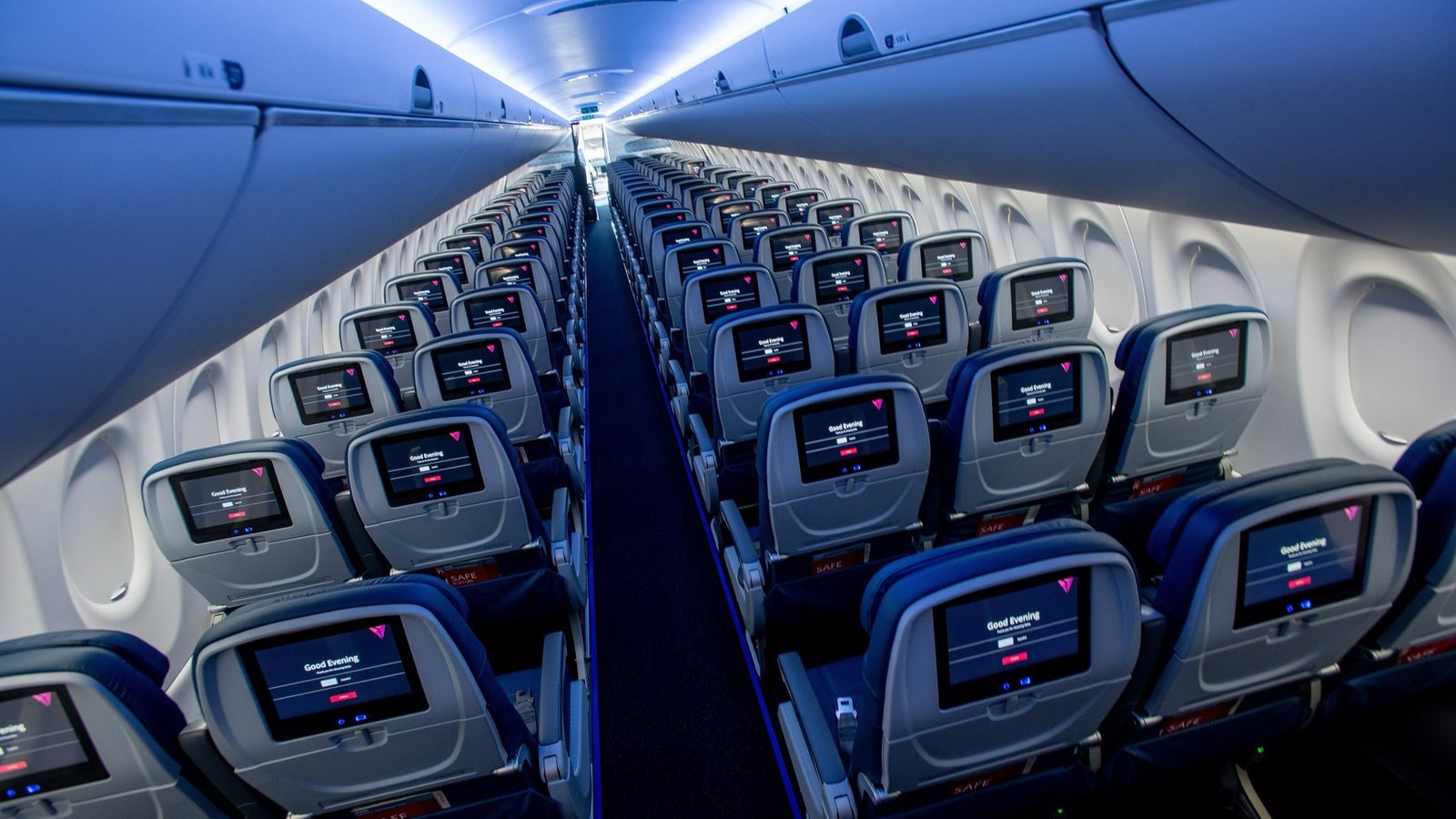
Aircraft cabin photograph by Delta News Hub, CC BY 2.0, via Wikimedia Commons.

.jpg)