
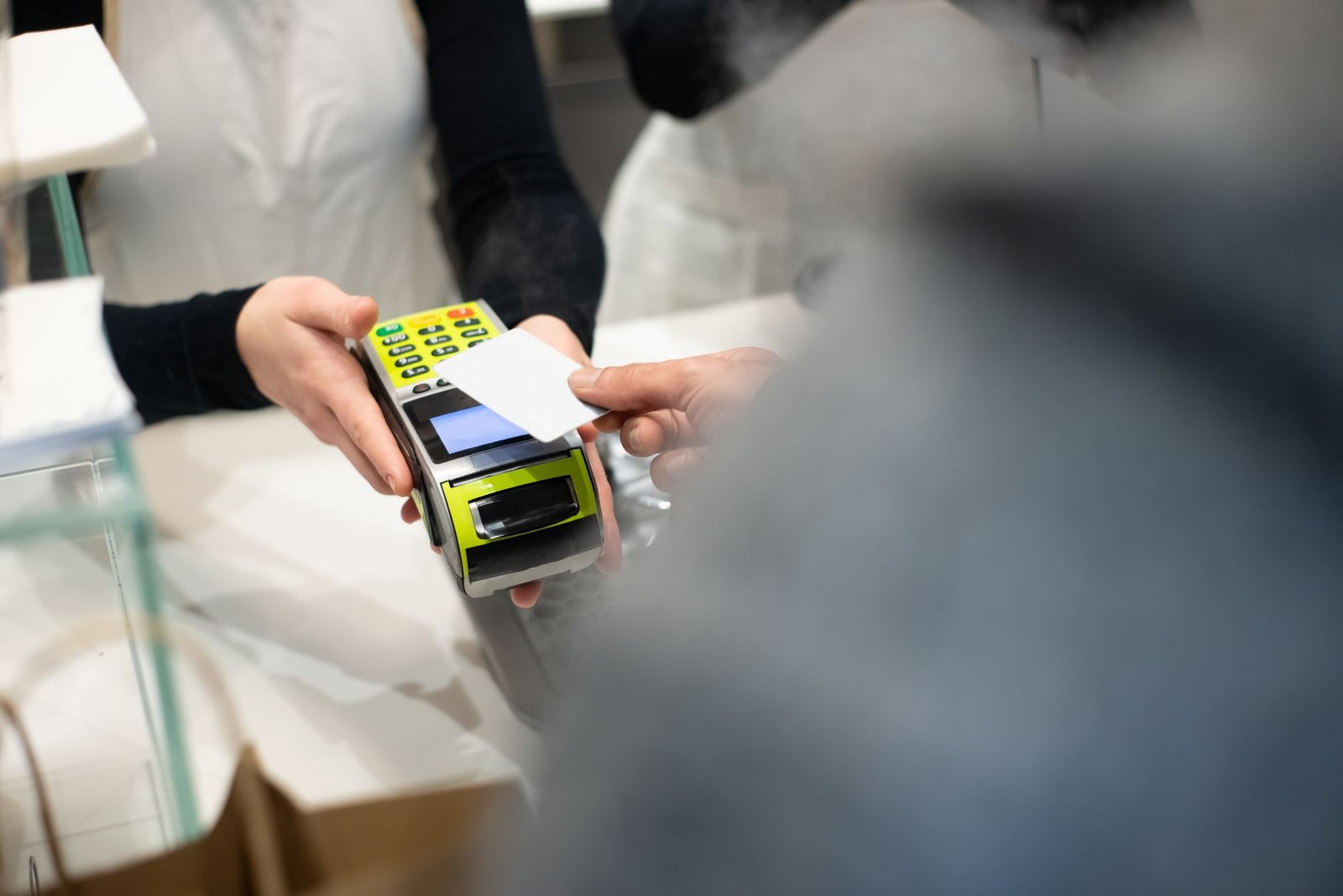
Every card transaction abroad is converted by somebody. The question is who, at what rate, and whether you were told the number before you pressed the green button. Get it right and the transaction costs you close to the interbank rate.
This is about the arithmetic, not the marketing. The useful part is that in the European Economic Area the numbers you need are legally required to be on the screen in front of you.
The short answer
Pay by card, in the local currency, always. When the terminal asks whether you want to be charged in your home currency, say no. Use cash where cards are refused and for small amounts, drawn from a bank ATM rather than a standalone machine in an airport or a tourist street. Carry a card with no foreign transaction fee if you can, and look up your own card’s markup before you leave.
| Criterion | Card in local currency | Card in your own currency (DCC) | Cash from an ATM |
|---|---|---|---|
| Who sets the rate | Visa or Mastercard | The merchant or ATM operator | Visa or Mastercard, then the ATM owner adds a fee |
| Rate you get | Close to interbank | A commercial rate, set by contract | Close to interbank |
| Markup shown before you confirm | Your card’s published fee | Required in the EEA, often buried | Both, on screen |
| Chargeback if it goes wrong | Yes | Yes | No, once it is cash |
| Works where cards are refused | No | No | Yes |
| Verdict | Best | Avoid | Useful in small doses |
What is actually being charged?
Four separate charges can land on one transaction, levied by different parties, which is why no single number is quoted to you.
- The card scheme’s conversion. Visa and Mastercard each publish a rate close to the interbank market. Since April 2021 Visa applies the rate available at authorisation.
- Your own bank’s foreign transaction fee, added on top of that rate. Visa’s own exchange rate calculator assumes 2 percent by default, but yours is whatever your card’s terms say.
- The ATM operator’s surcharge, if you are taking cash. That is the machine’s own fee, nothing to do with your bank.
- The dynamic currency conversion markup, if you accept the offer to be billed in your home currency. This replaces the scheme rate with the merchant’s own.
The first three are knowable in advance. The fourth is the one that catches people, and it is the only one that is optional.
Why is “would you like to pay in pounds?” the wrong answer?
That question is dynamic currency conversion. Accepting hands the conversion to the merchant or ATM owner instead of your card scheme. The transaction then reaches your bank already in your own currency, which is how the terminal can honestly say there is no foreign transaction fee. There is not. There is a markup instead.
Mastercard’s own merchant guidance is blunt about what that markup is. It describes it as “a commercial agreement between an acquirer and a merchant/ATM owner”, and adds that it “does not necessarily reflect a comparison to market exchange rates”. It is a price someone set, not a rate.
Visa says the same from the other side. Its exchange rate calculator warns that “if your transaction is converted by the merchant or ATM operator, the exchange rate indicated by this calculator will not apply”. The moment you accept, Visa’s rate stops being the rate.
The Financial Conduct Authority named that pitch in its May 2025 guidance on international payment pricing. Among its examples of poor practice is presenting the absence of a fixed fee as “zero cost” while charging an undisclosed markup. A screen saying no fees is describing one of the four charges above and staying quiet about another.
What are they legally required to tell you?
More than most travellers realise. In the EEA, Article 4 of Regulation (EU) 2021/1230 requires anyone offering currency conversion at an ATM or a till to “express the total currency conversion charges as a percentage mark-up over the latest available euro foreign exchange reference rates issued by the European Central Bank”, and says “that mark-up shall be disclosed to the payer prior to the initiation of the payment transaction”.
The same article requires both amounts before you commit, the sum in local currency and the sum in your own, and requires the terminal to tell you that you may decline and let your own bank convert. All of it must be “free of charge and in a neutral and comprehensible manner”. Your bank must publish its own markup somewhere accessible, which is how you look yours up before you travel.
Mastercard requires five disclosures before you are asked to choose a currency: your right to choose at all, the amount in local currency, the amount in your billing currency, the rate that would apply, and any other fee such as commission or VAT. The offer must come before you enter your PIN.
So the comparison is not guesswork. Read the percentage off the screen, compare it to your card’s fee, and pick the smaller. If no percentage appears, the disclosure you are owed is missing, and declining is the safe move.
Where does it go wrong in practice?
Mastercard’s guide lists the failures it audits for, and they read like a list of places travellers get caught.
- Car hire. The guide’s own example is a rental desk applying conversion automatically, with the detail buried in the paperwork. Check the currency on the agreement before you sign. That desk is also where the rest of the car hire charges get added.
- Hotels. Another is a hotel that takes your written currency choice and then converts its own way in the back office. Check the folio at checkout against what you ticked at check in.
- ATMs offering only accept or cancel, so declining means abandoning the withdrawal. That is a breach of the rules, not a choice.
- Steering. The cardholder “must not be required or encouraged” to use conversion, and no currency may be the default. A screen with your currency pre-selected, or the local option in smaller type, is not compliant.
- Contactless. Conversion may not be offered on contactless payments at or under the verification limit, so a tap should never raise the question.
If the choice was taken from you, tell your card issuer. Visa advises cardholders who see missing detail or feel pressured to decline and report it, and the paper trail matters if you later need to dispute the charge.
When is cash still the right call?
Cash loses on rate and on protection, and is still worth carrying. Markets, rural taxis, small restaurants, tips and left luggage run on it, and in much of the world a card is refused below a minimum spend. Being the person who cannot pay costs more than a 2 percent markup.
Draw it in one larger withdrawal, because the ATM surcharge is usually flat and splitting a week’s cash into four visits pays it four times. Use a machine attached to a bank rather than a standalone unit in an airport hall or a tourist strip, where the surcharge and the conversion offer are both worse. Decline the conversion at the ATM as you would at a till.
What cash does not give you is recourse. A card payment can be disputed and, on a UK credit card, larger purchases may carry statutory protection. Cash handed over is gone. Keep the card for anything expensive or prepaid.
What to do at the terminal
- Before you travel, look up your card’s foreign transaction fee and write the number down.
- At the till or the ATM, look for two amounts and a percentage. If the percentage is missing, decline.
- Choose the local currency. Euros in Spain, yen in Japan, baht in Thailand.
- If the screen offers only accept or cancel, cancel and use another machine.
- Keep the receipt and check the statement line against it.
- Draw cash rarely and in larger amounts, from a bank machine.
Frequently asked questions
Is paying in my own currency ever cheaper? It can be, and the screen tells you. If the disclosed markup is lower than your card’s foreign transaction fee, accepting is cheaper. That is uncommon, and it is the only case where the answer changes. On a card with no foreign transaction fee it is always no.
Does this apply outside Europe? The disclosure rules in Regulation (EU) 2021/1230 bind providers in the Union, so a terminal in Bangkok or Miami owes you nothing under them. Scheme rules still apply worldwide, including the ban on choosing for you. The advice does not change: pick the local currency.
What about a travel card or multi-currency account? They move the conversion to a provider you chose rather than one the shop chose, which is the point. Compare the provider’s markup and any weekend surcharge as you would a bank’s fee. Mastercard bars merchants from offering conversion on prepaid travel cards at all.
Credit card or debit card abroad? A credit card where it is accepted. It keeps the money in your account until the statement and, in the UK, brings stronger protection on larger purchases. Use a debit card at ATMs, where credit cards usually treat the cash as a loan from the moment you take it.
Should I buy currency before I go? A small amount for the first day. An airport bureau is the most expensive conversion in the chain, and a bank ATM on arrival beats it. The same logic applies to buying connectivity at the airport.
Sources: Regulation (EU) 2021/1230 of 14 July 2021 on cross-border payments in the Union, Article 4, which codifies and repeals Regulation (EC) No 924/2009; Mastercard, Dynamic Currency Conversion Performance Guide 2025, merchant version; Visa, Dynamic Currency Conversion Explained; Visa exchange rate calculator and its rate disclaimer; Financial Conduct Authority, Consumer Duty, international payment pricing transparency, good and poor practice (1 May 2025); and Directive (EU) 2015/2366 on payment services, Article 59(2).
Researched from primary sources and checked September 2026. Card terms and operator fees change often, so read the screen at the moment you pay. General information, not financial advice.
